

A missing tooth does more than affect your smile — it disrupts bite alignment, allows adjacent teeth to drift, and leads to bone loss in the jaw over time. According to the National Institute of Dental and Craniofacial Research, tooth loss is associated with a range of downstream oral health complications when left unaddressed. A dental bridge restores the missing tooth permanently — anchored to the teeth on either side of the gap using custom-fabricated crowns, with a false tooth (pontic) suspended in between.
At Alber Dental Studio in Boulder, Dr. Marc Alber and Dr. Lauren Llorente design bridges that are properly balanced for bite function and matched to your natural tooth color. We also discuss dental implants as an alternative when appropriate — bridges and implants each have clear advantages depending on your clinical situation, budget, and timeline, and we help you make the right choice for your specific case.

What Is a Dental Bridge?
A dental bridge is a fixed prosthetic that spans a gap left by one or more missing teeth. It consists of two dental crowns placed over the teeth on either side of the gap (the abutment teeth), with one or more artificial teeth (pontics) fused between them. The bridge is cemented permanently in place — it is not removable like a partial denture. Bridges are fabricated from tooth-colored porcelain or zirconia to match your natural teeth, and with proper care typically last 10 to 15 years or longer.
A bridge may be the right option if you have:
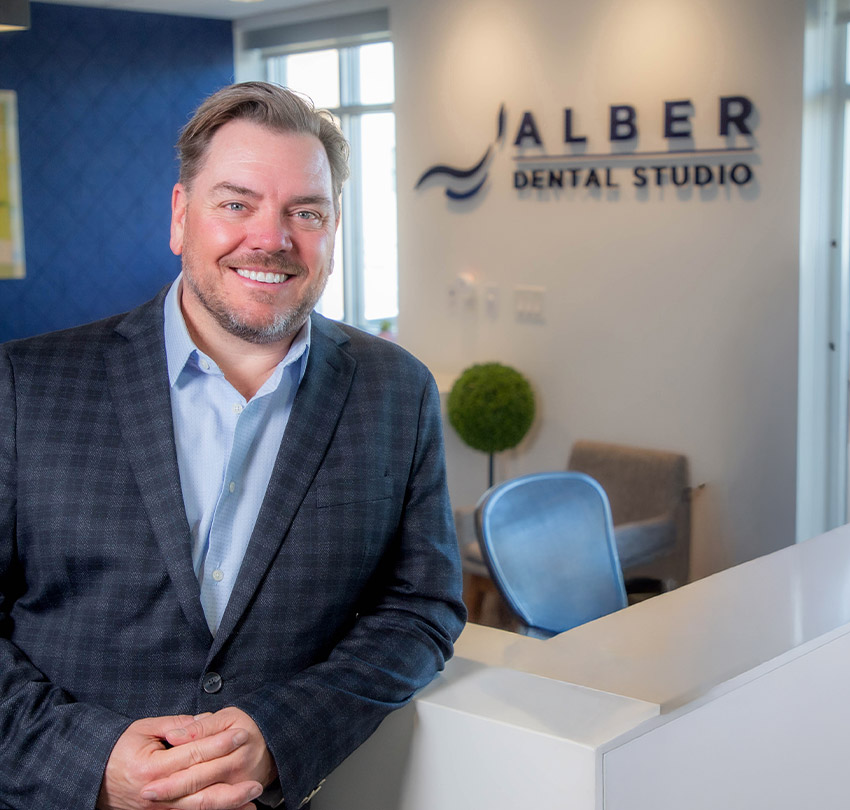
Dr. Marc Alber, DDS & Dr. Lauren Llorente, DDS
Dr. Alber and Dr. Llorente approach every bridge case with a focus on fit, bite balance, and long-term function. They take the time to discuss the bridge versus implant question honestly with each patient — including the clinical, financial, and timeline tradeoffs — so you can make the decision that is right for your situation. Both doctors have 26+ combined years of experience placing fixed restorations and are known for precise, natural-looking results.
As a fee-for-service practice, our bridge recommendations are based on your clinical situation and long-term oral health — not on what an insurance company will reimburse. We offer 0% financing through CareCredit, Cherry, and Altheon to make treatment accessible.

Getting a Dental Bridge at Alber Dental Studio
Bridge treatment typically takes two appointments over two to three weeks. Here is what to expect from consultation through permanent placement.
- Have healthy teeth and gums with no untreated decay or gum disease
- Want to address stains, chips, gaps, or irregular tooth shape
- Maintain good daily oral hygiene habits
- Do not grind excessively, or are willing to wear a night guard
- Have sufficient enamel to support bonding
- Are looking for a long-term cosmetic investment
Dr. Alber will confirm veneers are the right fit during your consultation — and clearly explain any alternative if they’re not.
The Porcelain Veneer Process
Exam & Treatment Planning
Dr. Alber examines the gap, evaluates the abutment teeth on either side, and takes digital X-rays to confirm their health and suitability for crown placement. He discusses bridge versus implant options and explains the full cost and timeline for each before you make any decisions.
Tooth Preparation & Impressions
The abutment teeth are prepared under local anesthesia — a thin layer of enamel is removed from each to accommodate the crown portion of the bridge. Impressions are taken and sent to the dental lab. Temporary crowns are placed over the abutment teeth to protect them while the permanent bridge is fabricated, which typically takes two to three weeks.
Bridge Delivery & Final Placement
When the lab returns the permanent bridge, Dr. Alber seats it over the abutment teeth temporarily to verify fit, color, and bite before final cementation. Adjustments are made chairside as needed. Once everything is confirmed, the bridge is permanently cemented and polished. You leave with a fully restored, functional smile — no further appointments required.
Bonding & Final Polish
Permanent veneers are placed, adjusted for fit and bite, bonded with light-cured adhesive, and polished for a seamless result.
Missing a Tooth? Let's Talk Through Your Options.
We’ll review whether a bridge or implant makes more sense for your specific case — clinically, financially, and for your timeline. Schedule a consultation and leave with a clear plan and honest cost estimate.
Dental Bridge vs. Dental Implant
Dental Bridge vs. Dental Implant
Both are effective tooth replacement options. The right choice depends on your bone density, timeline, budget, and the condition of your adjacent teeth.
| Dental Bridge | Dental Implant | |
|---|---|---|
| Treatment timeline | 2–3 weeks total — two appointments | 3–6 months including osseointegration |
| Surgery required | No — no incision or bone work | Yes — implant post placed surgically |
| Bone preservation | Does not prevent bone loss under pontic | Preserves bone — root-like stimulation |
| Adjacent teeth | Requires crowning healthy adjacent teeth | Adjacent teeth not touched |
| Longevity | 10–15 years with proper care | 15–25+ years; can last a lifetime |
Caring for Your Bridge
How to Make Your Bridge Last
Bridges are durable and low-maintenance with proper hygiene habits:
Food debris accumulates under the pontic (false tooth) and can lead to decay in the abutment teeth. A floss threader or water flosser reaches this area; standard floss cannot pass under the bridge on its own.
Porcelain and ceramic bridges can chip under excessive force. Treat the bridge like a natural tooth — avoid ice, hard candy, and using teeth as tools.
Routine professional cleanings remove the deposits that accumulate under and around bridge margins. Dr. Alber also checks the abutment tooth margins at each exam to catch any early decay before it compromises the bridge.
Bridges are durable but not permanent. With proper care, most last 10 to 15 years before replacement is needed. Dr. Alber monitors your bridge at every six-month exam and will let you know well in advance if signs of wear or margin issues suggest replacement is approaching.

Dental Bridges With Flexible Payment Options
Dental bridges are often partially covered by dental insurance when placed for restorative reasons. As a fee-for-service practice, we provide a full cost estimate before any treatment begins. We offer 0% financing through CareCredit, Cherry, and Altheon to make tooth replacement accessible regardless of your coverage situation.
Related Tooth Replacement Services
Tooth Replacement Options at Alber Dental Studio
Bridges are one of several tooth replacement options we offer. We review all relevant options at your consultation so you can make the decision that’s right for your specific situation.
The gold standard alternative to a bridge — implants preserve bone and don’t require crowning adjacent teeth. We discuss both options at your consultation.
The abutment teeth on either side of your bridge receive CEREC same-day crowns — meaning many patients complete the full bridge in fewer visits.
For patients missing multiple teeth in different areas, partial or full dentures may be a more appropriate solution than a bridge. We review all options at your consultation.
Lost a tooth due to trauma or infection? We offer same-day emergency appointments and can discuss bridge and implant replacement options at that visit.
Read What Our Customers Are Saying
Common Questions
Frequently Asked Questions
How long does a dental bridge last?
With proper care, a dental bridge typically lasts 10 to 15 years. Longevity depends on daily oral hygiene — especially cleaning under the bridge with a floss threader or water flosser — along with avoiding biting hard objects and attending regular six-month cleanings. Dr. Alber monitors your bridge at every exam.
Does getting a dental bridge hurt?
The procedure itself is performed under local anesthesia and should not be painful. Some sensitivity and mild soreness around the abutment teeth is normal for a few days after preparation. This is similar to what you would experience after getting a dental crown and typically resolves quickly with over-the-counter pain relief.
Will a dental bridge look natural?
Yes. Porcelain and zirconia bridges are custom-shaded to match your surrounding natural teeth. Most patients find that their bridge is indistinguishable from their natural teeth. Dr. Alber takes photographs and evaluates the shade match carefully before the bridge is sent to the lab and again at final placement.
Can I eat normally with a dental bridge?
Yes, for most foods. A bridge functions like natural teeth for normal chewing. We recommend avoiding biting directly into very hard foods — ice, hard candy, and crusty bread — on the bridge side. Sticky foods that could dislodge the bridge should also be minimized. Otherwise, there are no major dietary restrictions.
Is a dental bridge better than an implant?
Neither is universally better — the right choice depends on your clinical situation. Bridges are faster, less expensive, and don’t require surgery, but they require crowning healthy adjacent teeth and don’t preserve bone under the pontic. Implants are more invasive and take longer, but they preserve bone, don’t affect adjacent teeth, and typically last longer. Dr. Alber reviews both options honestly at your consultation so you can make the decision that fits your priorities.
How do I clean under a dental bridge?
Standard floss cannot pass under the bridge on its own. You need to use a floss threader to guide floss under the pontic, or use a water flosser, which many patients find easier. Cleaning under the bridge daily is the single most important hygiene habit for preserving the abutment teeth and extending the life of your bridge.
Replace Your Missing Tooth With Confidence
Dr. Marc Alber and Dr. Lauren Llorente have spent over 26 combined years helping Boulder patients restore their smiles with durable, natural-looking results. Our fee-for-service practice serves patients throughout Superior, Louisville, Broomfield, Longmont, Erie, and the surrounding Front Range. Schedule a consultation online or call our team — we’ll review all your options and help you make the right decision for your smile.